

SAI Spotlight: Command Sight

Let there be light – again! After a hiatus last year, the SAI Spotlight series returns for its fourth edition to zoom in once more on one of Shively Acoustics International’s (SAI) past projects in the industry. We’re a versatile company, and our expertise – grounded in acoustics and audio technology – can be applied to a variety of creative endeavors far and beyond the realm of the conventional loudspeaker. At times, we feel like we’re working on something bordering on science-fiction… feel it in our bones.
In SAI Spotlight #4, we shine the light on a company closer to home here in the PNW: human-to-canine communication technology specialist Command Sight, Inc. (Seattle, Washington; www.commandsight.com).
Background

Command Sight was founded in 2017 by CEO A.J. Peper with an aim to “change the way we interact with our animal companions by developing bridges between human and animal communication”. Peper had a variety of areas in mind for this, from the highly specialized to the everyday, with the company’s initial project geared towards application in the military and defense sectors.
Consider the situation of Military Working Dogs (MWD): highly trained animals that work alongside human handlers within a military force in security, combat, or detection roles, serving in high-stakes missions in dangerous areas. In such cases, the dogs may often go where a human will not, or at least in advance of the human. Here communication between the canine and its handler becomes paramount, naturally along with safety concerns as the distance between them increases and the line of sight is broken.
For this, Command Sight developed its Canine Head Mounted Display (HMD). Using its own patented augmented reality (AR) technology, an embedded camera relays the dog’s line of sight back to the off-site handler, allowing them to see what their canine partner is seeing in real time. The out-of-sight human handler can then assess the dog’s environment, highlighting objects/areas for further investigation, cues that are seen directly by the dog – and only the dog – via AR in its head-mounted display.
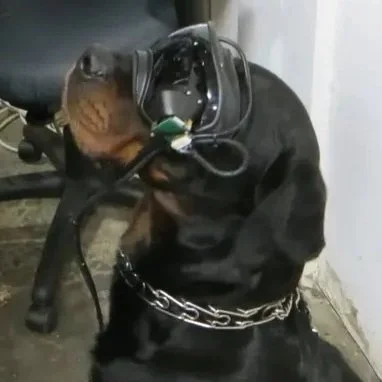
Canine HMD (Photo: Command Sight)
Cool stuff. By around 2020, Command Sight had secured a grant from the US Department of Defense (DoD) and was working directly with the military, developing the prototype with the Joint Base Lewis-McChord (JBLM) just southeast of Tacoma, and the AR headset was a real thing out in the world. To drive home just how ground-breaking this was, the device later made it into the Guinness World Records in 2022 as the “First canine AR goggles”. Learn more about Peper’s experience with the project in his own words here.
But wait, let’s not get carried away here – SAI is an acoustics company, not an optics one. It’s in the name. So, what’s this got to do with us? Well, the head-mounted display with its AR-enhanced video communication wasn’t the end of the road. As the next step, Command Sight wanted to develop an audio product to go along with it. Why only send visual cues to your canine partner, when you could talk with them, too? Sounds good (pun intended). But when the target environment is one where silence is golden, the solution requires much more sophistication than the noisy communication of a conventional walkie-talkie or the like…
SAI and Command Sight

Command Sight found out about us the way many of our current clients have and how many of our future customers will: through COMSOL, with whom we have been a certified consultant since 2020. This initial contact was in late March 2023, just as Shively Acoustics International itself was being founded in the transition away from our predecessor company. By then, Command Sight had already been tinkering away on a canine bone-conduction audio prototype, developing the concept with an external partner.
Such an audio device makes perfect sense, given the context: in a conflict zone, an MWD must be able to carry out its mission as soundlessly as possible in order to go undetected. Nevertheless, pairing remote voice signals with the aforementioned visual cues would be ideal in increasing the efficiency of a handler’s commands. By employing bone conduction here, the medium of the air is removed from the equation, and the audio signals are rerouted instead through a bone in the canine’s skull – specifically, the mastoid process of the temporal bone, just behind and below its ear – on their way to its brain. This allows the dog to feel the conversation just as much as it “hears” it, all the while freeing up its ears to focus solely on its immediate surroundings.
To this end, what Command Sight was building was in essence a dog collar with a pair of attached transducers that would rest on the skin over the dog’s mastoids on either side. And instead of emitting soundwaves out into the air, the transducers would send them inwards, directly into the bone. The company had its concept by now, along with a workable prototype built with their provider’s transducers, but no way to simulate it or properly verify its design. For this, they turned to Shively Acoustics, having learned via COMSOL of our simulation expertise and previous experience working on bone-conduction headphones (for humans, of course).

To boil it down: Command Sight came to us with an audio product that was making too much noise. The assembly housing for the transducers was vibrating too much, leaking sound out into the air. Inefficient, suboptimal, not good enough.
Adding complexity to matters: not only did the energy loss – related to both noise radiation and coupling the transducer efficiently to the bone – need to be prevented, but the thing also needed to be physically robust. The collar would still need to withstand high-altitude pressure, submersion in water, dropping, contact with sand/dirt, etc. and be essentially airtight. Of course, the transducers would still require some internal space to move in order to work at all.
SAI’s task: optimize a durable design that allowed internal movement but sealed off the external environment, while maximizing transducer performance and minimizing noise. And so we did just that, and within the calendar year.
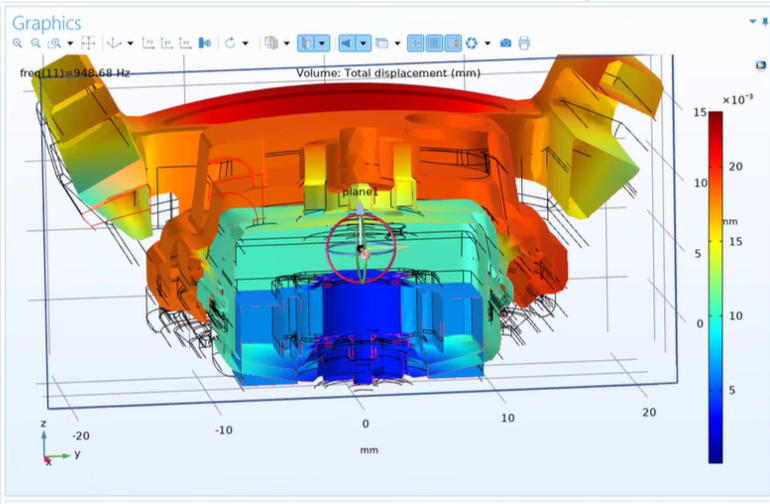
Modeling our new design in COMSOL’s Multiphysics (Image: SAI)
We began a review of the overall concepts and existing design that Command Sight was working with, both the transducer itself and its housing assembly and contact points with the collar. Once we understood how it worked, optimizing it meant not only getting more output from the transducer, but also in the right direction, i.e. reducing the external output while increasing energy inwards to the bone.
By June 2023, we were deep into simulation work with COMSOL’s Multiphysics software. As a necessary first step, we determined the optimal Maximum Output Hearing Levels (MOHL) in terms of input force level (over an appropriate frequency range) on the the dog’s fur/skin, i.e. maximizing the force output from the transducer while minimizing any attenuation due to either the fur/skin or misalignment to the conducting bone. Doing this would maximize bone conduction and thus the quality of the dog’s perception. We determined a median MOHL of 72-75 dB. Transducer optimization: ✅
Next, structural and material changes. Observing the design in simulation, we got an idea of how the walls were physically moving in the existing set-up. This also made it clear that there was too much space between the transducer and the collar (green in the top cross-section below). We started by adding damping to this empty-air cavity. While the existing design had some foam there already, we inserted highly compressed foam (the upper orange piece in the bottom cross-section) that expands to fill up that space entirely (see images further below: yellow part on the left).
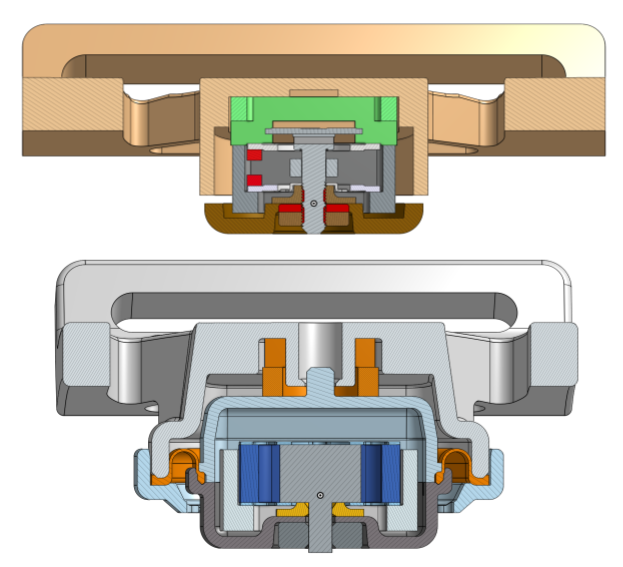
Cross-sections of Command Sight’s existing design (top) and SAI’s improved design (bottom; Images: SAI)
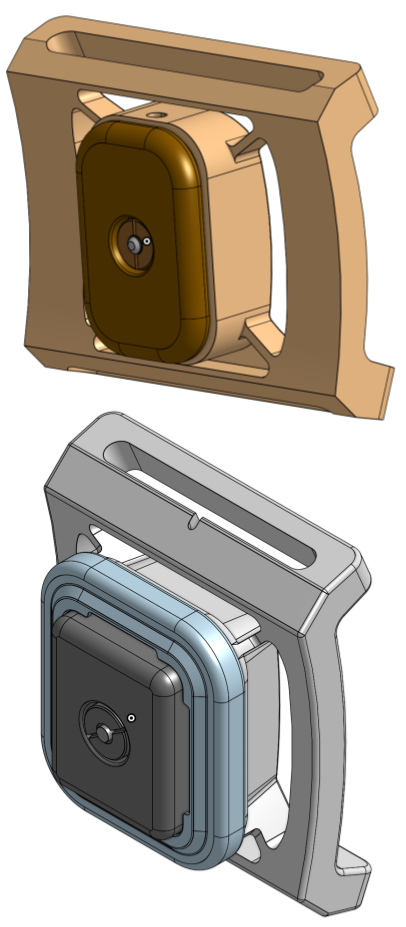
SAI’s design: more compact and structurally sound (Images: SAI)
To optimize the transducer’s movement, then, we instead designed a gap around its housing and added suspension there to control it. These are the orange parts at the sides in the bottom cross-section above. The suspension works both to decouple the transducer from the collar housing, allowing the transducer to move more freely in the direction of the dog’s skin, while simultaneously sealing off the space from water, sand, and other debris – all in a more structurally sound and compact design. Elegant.
Then there was the back panel of the transducer’s housing, the surface that directly touches the dog’s skin. We swapped out the hard plastic for a flexible soft rubber, which more easily gives way, helping to conduct the radiation output in the desired direction. This is the dark gray piece at the bottom of the new design’s cross-section. Additionally, we made the structure of the collar connector (the yellow part in the right image below) more compact and changed its material to a flexible strong rubber for better durability over the hard plastic in the existing design.
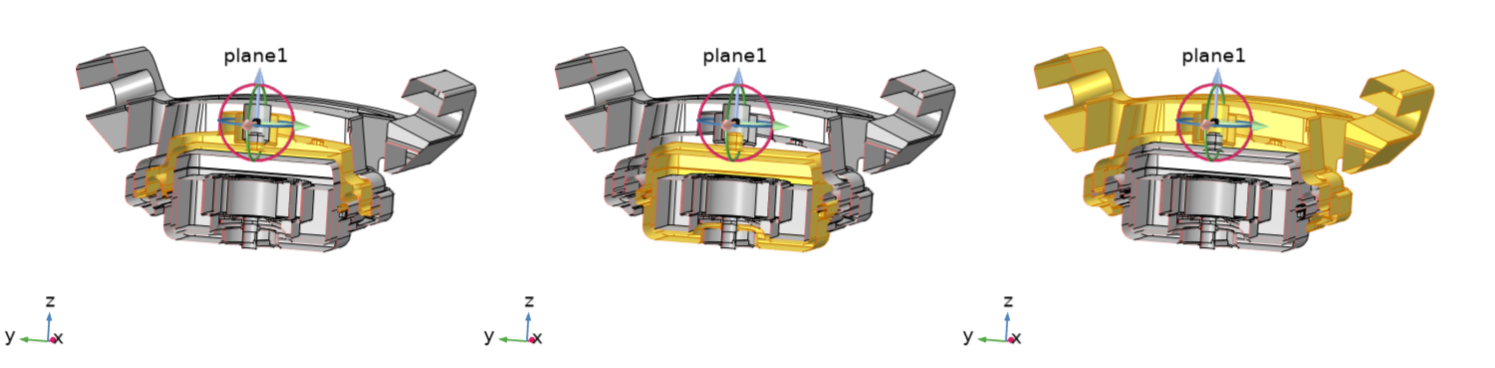
More visuals (in yellow): gap filled by expandable foam (left), transducer housing (center), and collar connector (right; Images: SAI)
This phase of design optimization was complete by December 2023, though we continued working with Command Sight and their transducer supplier through the turn of the year into January 2024. The company now had a viable design and a technology that functioned as intended, with a canine test partner hearing a handler through its bones in an entirely private human-to-animal conversation.
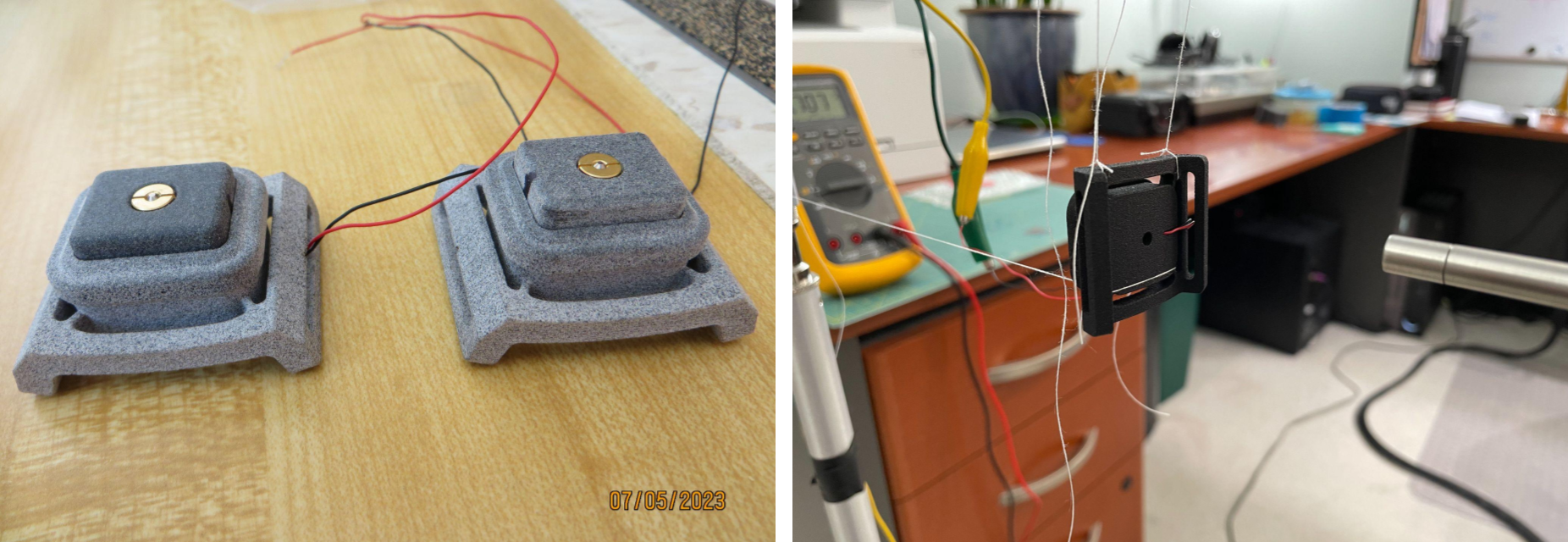
Testing early prototypes of the new design (Photos: SAI)
At that point, our work on the project was finished. Except, not really. There are always follow-ups and fine-tuning. Later that year in November, as Command Sight was preparing its grant proposal for the DoD, the company came back to us for help in writing the technical overview of an intended, future second phase of simulation and performance testing and improvements. After lending an SAI hand, the grant proposal was submitted on November 20, 2024, and things sure were looking good.
DOGE bites Dog

Well, this doge had his day, at least… (Photo: Gage Skidmore / Wikimedia / CC BY-SA 2.0)
And so, everything worked out in the end, right? The proof of concept was successful: the technology worked, plain and simple, and a dog wearing the collar was able to “hear” the commands and act on them accordingly. Command Sight and SAI were geared up for another long-term project to make a great design even better. Meanwhile, the ins and outs of this innovation had been laid out for an interested JBLM in a new grant proposal on its way to the Department of Defense for the greenlight. And in the time since, the bone-conduction collar became a reality, joining the Canine Head Mounted Display in the annals of world records… right?
Well, not quite. Despite the original interest and its initial, technical success, the project met with bad timing and the arrival of the Department of Government Efficiency and Elon Musk’s chainsaw. In March 2025, the grant was not awarded and the project was cancelled as part of the flurry of DOGE-initiated budget cuts. And that’s that. Way she blows.
Determining that there was no other immediate commercial value for it, Command Sight shut down the operation and it now lies dormant, an example of a technology lost just before release and its moment to shine. Furthermore, there might be a question of such a thing ever finding a proper place in a future where military operations are increasingly dominated by drones and AI – though that’s one we can’t answer, only speculate on. Whether it could be resurrected for application in civilian and consumer sectors remains to be seen – or heard. Felt? Hope springs eternal.
Meanwhile, and speaking of AI, CEO A.J. Peper has moved on to a new project, another that has man’s best friend front and center: Fluffy Pet Technologies. Peper’s new venture targets dog daycares with the offer of automated AI-powered digital after-visit reports that can be sent to customers to “give pet parents the peace of mind that their dog is safe, healthy, and most importantly, having fun with friends”. Ever the entrepreneur, ever the creative mind. Cool stuff, as always. 😉
Next week
Shively Acoustics is headed to Denmark for a three-day dose of hygge to cap off the month. Our version of it, anyway: the AES Europe 2026 Convention on Intelligent Audio from May 28-30. Come get cozy in Copenhagen with us for our last big audio event before we pivot full steam ahead to the AES Automotive Audio 2026 International Conference in Detroit this summer (July 29-31). If you haven’t yet, register now to attend – it’s nearly here, guys!!!


That’s a wrap, folks. Onwards to Copenhagen! ■

Shively Acoustics International — Modern Audio Solutions, Worldwide