

“Less, but better”

Late Saturday morning in early June, a sunny and pleasant day in Frankfurt am Main, the stomping grounds of yours truly. While the German metropolis’s skyscraper-heavy, finance-oriented central district – not so affectionately dubbed “Mainhattan” – often looms large in the minds of many, much more can be found with a bit of exploring, including a hidden gem for you audiophiles out there.
A short walk away from Mainhattan brings you riverside, a fine spot to stroll with a coffee, watch the boats and kayakers float by, and seek out some culture. Nestled in the Museum Embankment along the south side of the Main, clad in a modernist grid of white enameled steel and glass panels, is the Museum of Applied Art. With its central focus on design, the museum is also home to a Style Room dedicated to German industrial designer Dieter Rams.
For this edition of the SAI Blog, then, let’s meander a bit off course from the usual subject matter, and take a brief moment to appreciate the man who helped change consumer audio design forever.
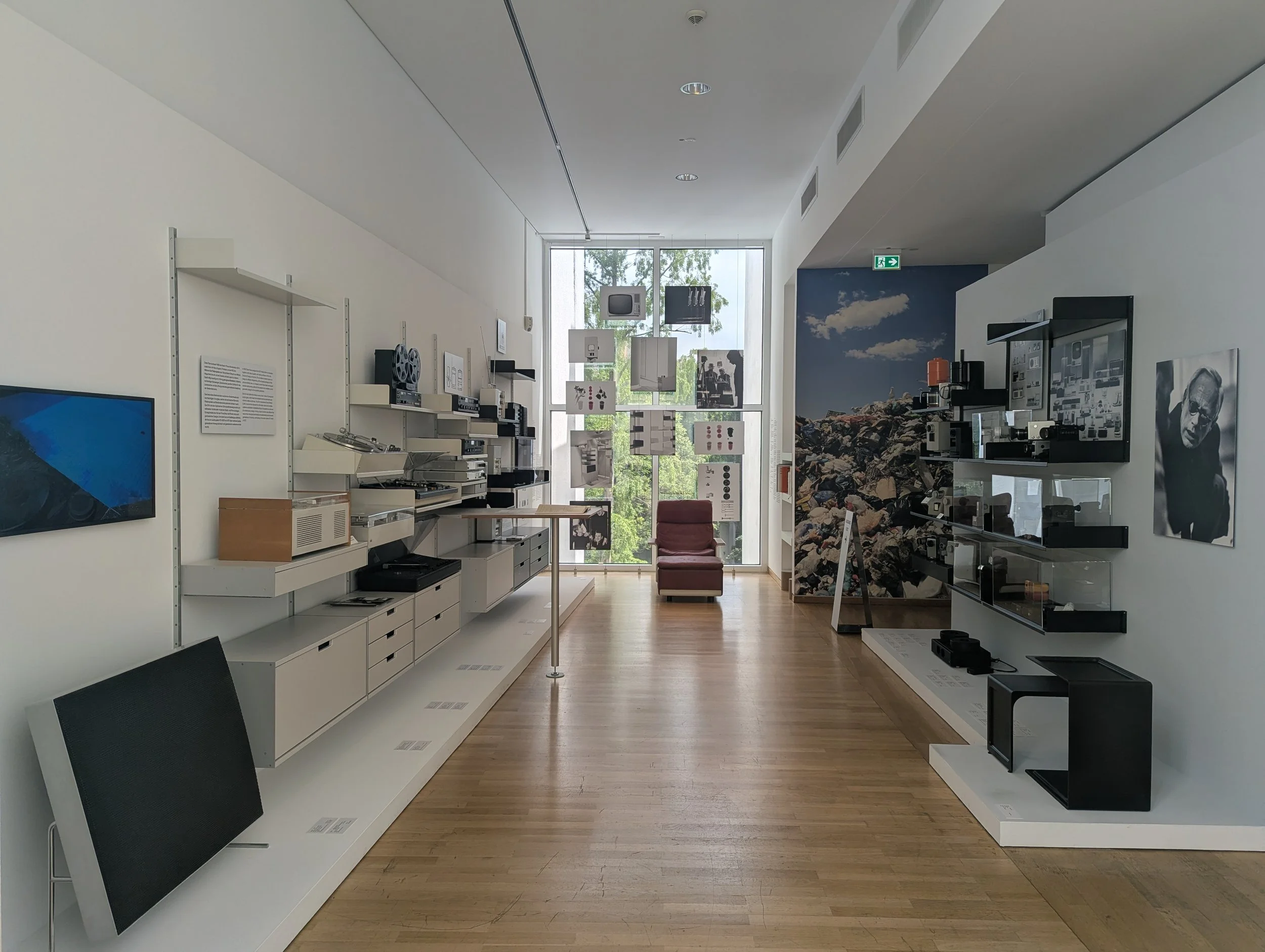
The Dieter Rams Style Room at the Museum of Applied Art in Frankfurt, Germany (Photo: SAI)
Dieter on display
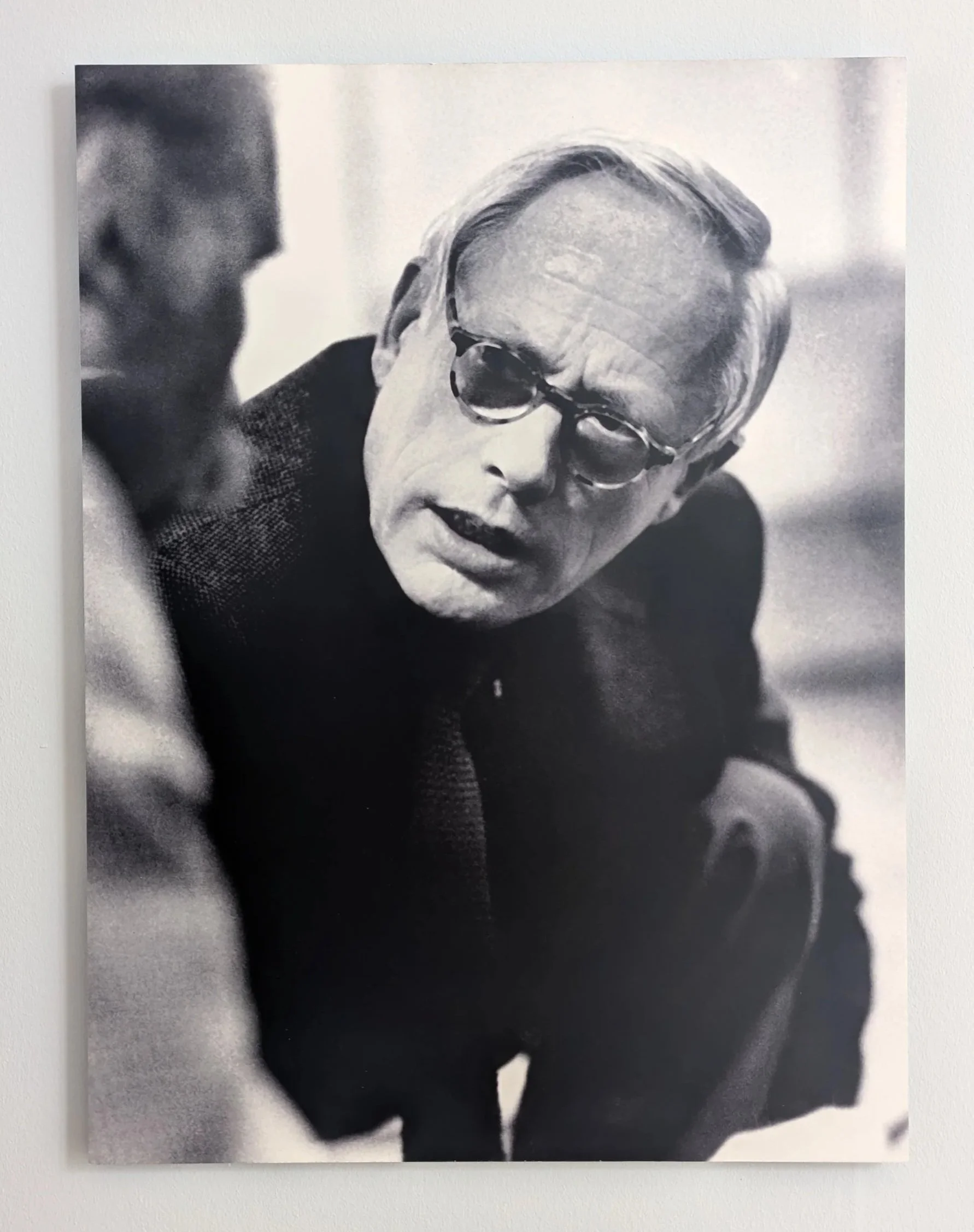
Born in the nearby state capital of Wiesbaden on May 20, 1932, Dieter Rams began studying architecture and interior design at the city’s then-School of Arts and Crafts in 1947, managing to complete a carpentry apprenticeship during this time as well. He later moved to Frankfurt, where from 1953 he worked at an architecture office for two years.
In 1955, Rams joined the Frankfurt-founded consumer products company Braun as an architect and interior designer, kicking off a revolutionary career that would span more than forty years. In 1961, Rams was appointed Head of Design at Braun, a position he would hold until 1995 before his full retirement in 1997. Though his timeless influence has never waned, it was the early period from the mid-1950s through to the 1970s that established his name and defined his legacy.
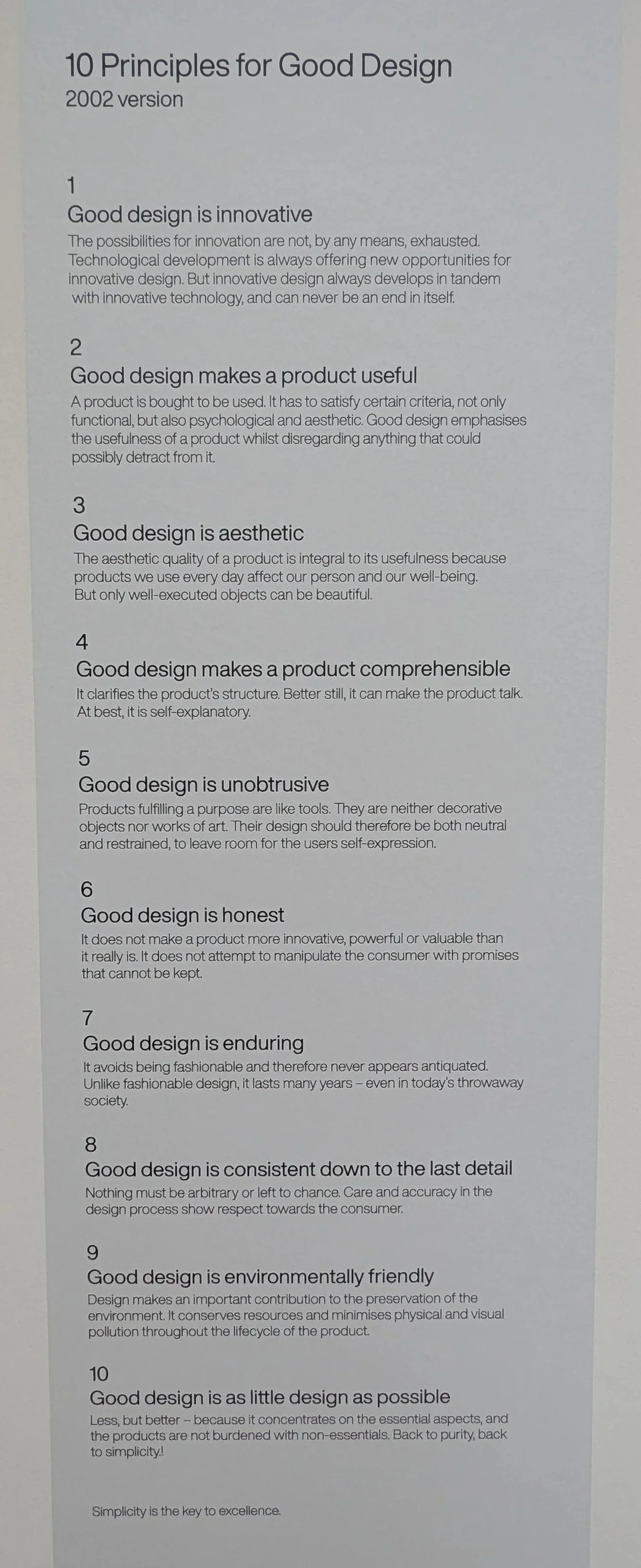
Design for Dieter Rams centered around the ethos “Weniger, aber besser” – “Less, but better.” Around this foundation, Rams developed his now well-known 10 Principles for Good Design, first published in the mid-70s, which the Style Room presents to the visitor at the entrance, before anything else, and are as follows:
Good design is innovative
Good design makes a product useful
Good design is aesthetic
Good design makes a product comprehensible
Good design is unobtrusive
Good design is honest
Good design is enduring
Good design is consistent down to the last detail
Good design is environmentally friendly
Good design is as little design as possible
Entering the latter half of the 20th century, Rams and his team at Braun were fundamentally changing the identity of the consumer product and bringing it into the modern age. While he designed items used in all aspects of daily life – from furniture and kitchen appliances to personal care and desk accessories – his “less, but better” vision might have been best embodied by his work on audio equipment such as record players, tape recorders, or loudspeakers.
Where before these were heavy, bulky, intrusive appliances camouflaged in overly ornate furniture that dominated a home’s space, Rams revealed sleek, portable instruments with functional essentials at the forefront. Where before the consumer faced overwhelming layouts and decorative controls, Rams presented them with a rationalized, accessible, and intuitive interface. Where before these were merely household machines, Rams turned them into iconic objects of lasting value. Rams did away with the noise.
The Style Room – only just reopened to the public at the end of May, after an update in celebration of the visionary’s birthday (his 94th) – features some of the consumer audio products he designed in this groundbreaking era. The most iconic of these has to be the 1956 SK4 radio-phono combination, nicknamed “Snow White’s Coffin”, a harbinger of the modern tech aesthetic. Clean sheet metal sandwiched between two thin wooden panels, with strictly linear, axis-aligned controls, topped off with a revealing acrylic lid:
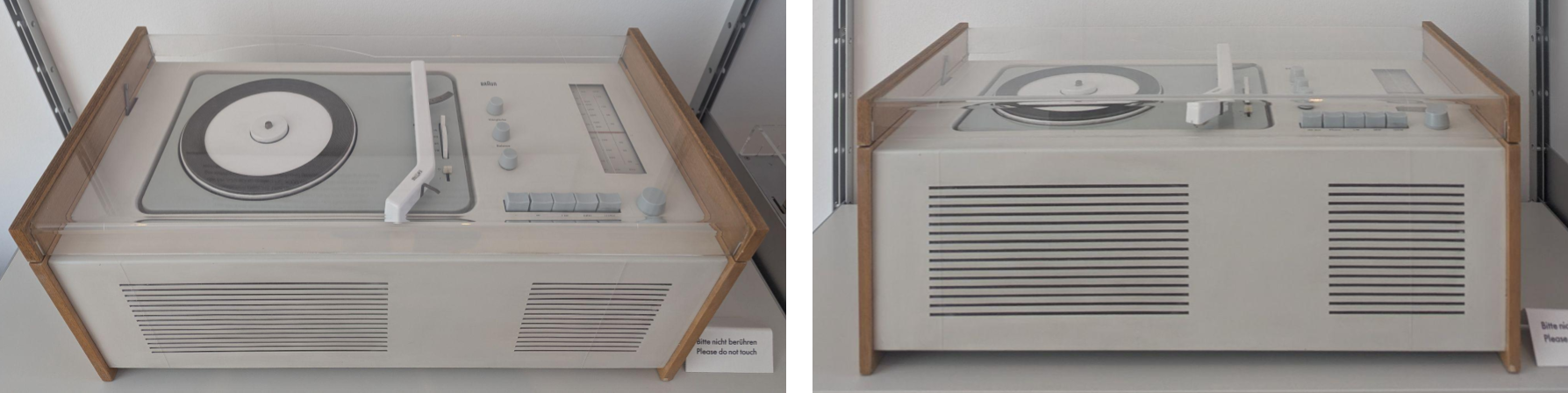
The SK4, aka “Snow White’s Coffin”, on display in the Dieter Rams Style Room (Photos: SAI)
Setting a decades-long standard, the importance of the SK4 for design can’t be overstated. So much so that a second unit can be found outside of the Style Room entirely, tucked among the myriad items of the museum’s permanent, flagship “Elementary Parts” collection exhibiting multiple eras and applications of design side by side.
What else? How about the ahead-of-its-time 1959 LE1 electrostatic loudspeaker? Thin, minimalist, almost floating, suspended in the future on its wire frame – decidedly not a cone in a big wooden box:
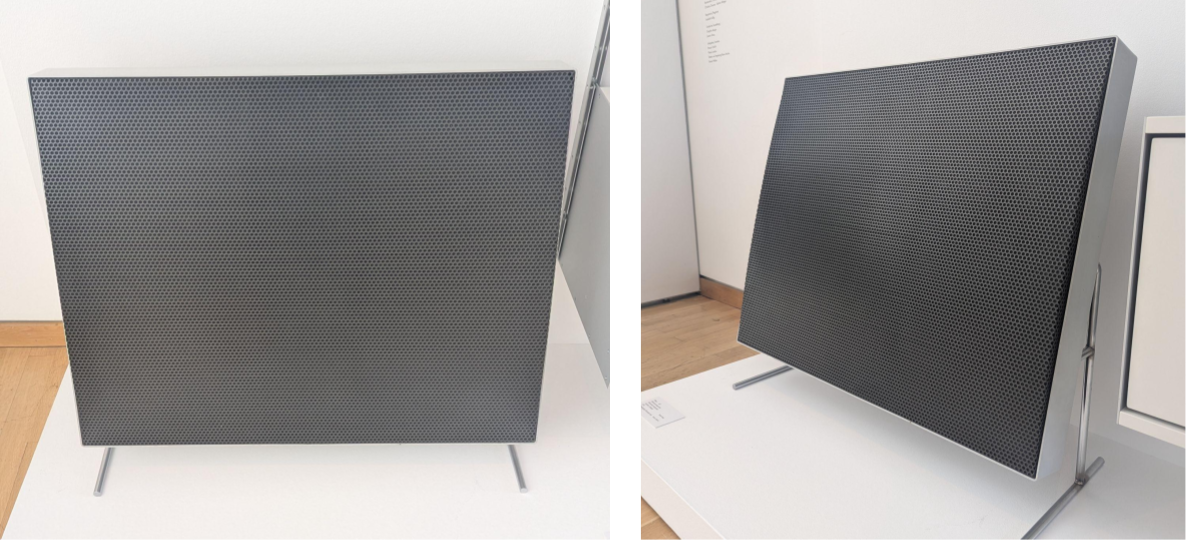
A futuristic marvel sent back in time to the 50s, the LE1 electrostatic loudspeaker (Photos: SAI)
Picking up where the SK4 left off was the 1962 audio1 radio-phono combination. Wood has been ditched entirely as a material in favor of a completely industrial, metal look. The controls are even more rigorously laid out. The speakers have been moved offsite: the audio1 is its own component, meant to be a central control hub.
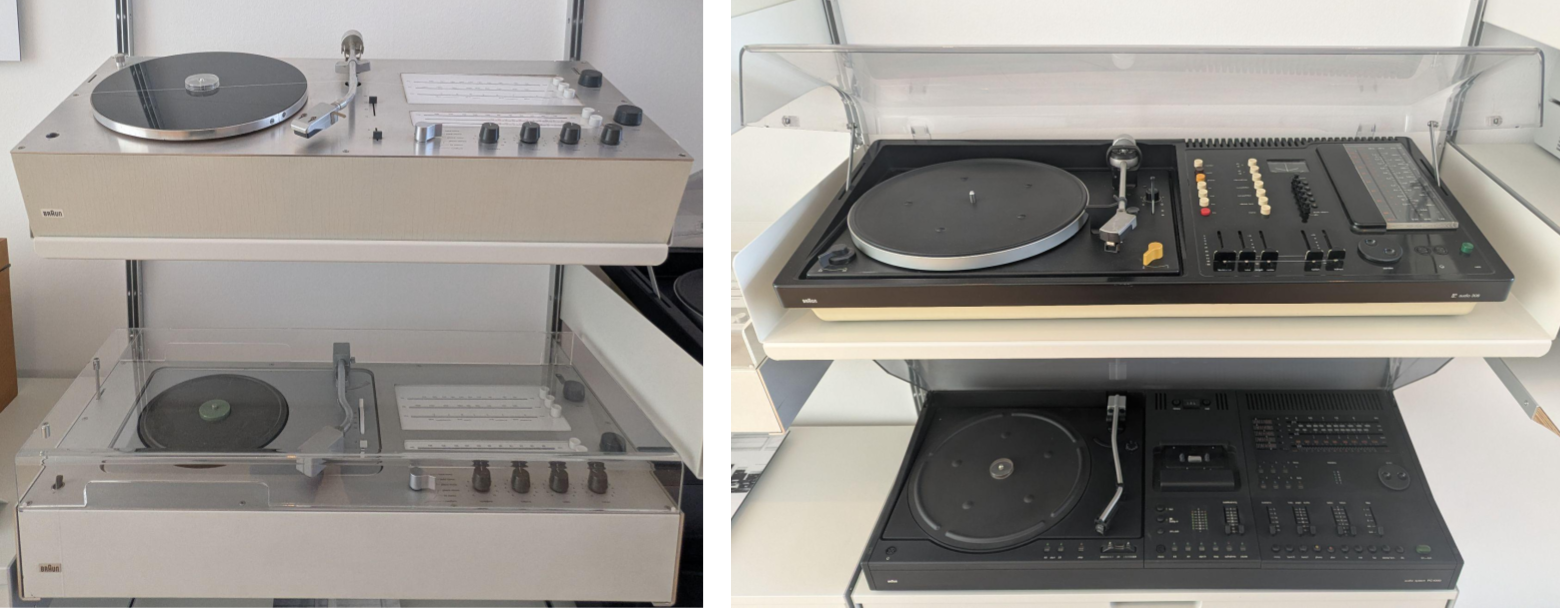
Left: 1962 audio1 radio-phono combination (bottom) & 1960 design model (top). Right: 1973 audio308 compact radio and record player (top) & 1974 PC 4000 compact radio and tape recorder (bottom; Photos: SAI)
Enter the 1970s, with sleek chrome giving way to ruthless black matte plastic and knobs evolving into more precise multi-channel slider controls. This aesthetic is encapsulated by 1973’s audio308 compact radio and record player and 1974’s PC 4000 compact radio and tape recorder, the latter with an integrated cassette tape deck as a novel feature.
Scaling things down are the 1972 L260 loudspeaker and the 1978 travel1000 world receiver, both packing a portable, compact punch:
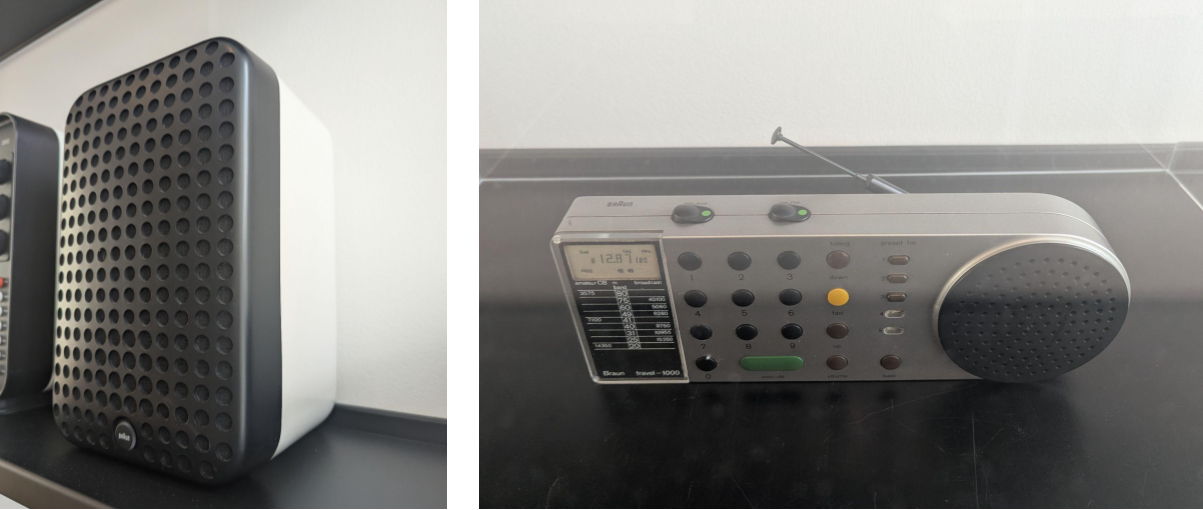
The bookshelf-appropriate 1972 L260 loudspeaker (left) and on-the-go travel1000 world receiver (right; Photos: SAI)
That quick two-decade visual journey is but a slice of what all there is to experience in the Dieter Rams Style Room. Tape recorders, world receivers, video cameras, a TV, coffee grinders, hair dryers, and furniture items designed by Rams – including one of his classic armchairs and foot rests – are also on display. All of this fits neatly into what is a modest, compact exhibition space – after all, “less, but better”.
SAI stuff
Before signing off, some housekeeping as we cross the year’s midpoint. First, don’t miss a special “after dark” webinar from the Audio Product Development Alliance (APDA) coming up on June 23. In a departure from the typical APDA Webinar, join us and a guest (TBD) for a more informal roundtable discussion with an Automotive Audio focus. While on the subject: be on the lookout for a pair of articles (yes, 2!) from SAI president Roger Shively covering automotive topics due to appear in the July issue (pub. end of June) of audioXpress. Finally, as previously mentioned, University of Washington mechanical engineering student Nathaniel Jocson is joining SAI this summer as our next intern, starting on July 1.
The SAI Blog will be back before you know it. Check in again in early July for our final look ahead at the 2026 AES Automotive Audio Conference – register now before the early-bird rates are gone! ■

Shively Acoustics International — Modern Audio Solutions, Worldwide